
Compassionate Conversation: Jay Van Bavel and Stuart Soroka discuss false polarization before midterm elections
Wednesday, Oct. 28, 2026
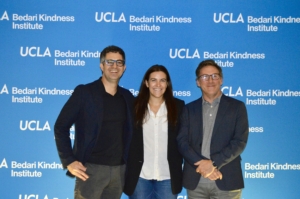
From left to right: Professors Jay Van Bavel, Aliza Luft, and Stuart Soroka. Photo by Hannah Park.
By Hannah Park
On Wednesday, October 28, the Bedari Kindness Institute (BKI) launched the third year of its Compassionate Conversations series with “Beyond the Divide: What the Science of Polarization Reveals, Right Before the Midterms.” It featured Jay Van Bavel, New York University (NYU) professor of psychology and neural science, and Stuart Soroka, UCLA professor of communication and political science, in conversation with Aliza Luft, professor of sociology and interim director of the BKI.
Drawing on their different disciplines, the panelists demonstrated that it is crucial to understand the drivers behind increased polarization while being aware that social media amplifies political differences—making them appear more extreme than they actually are. They also explored what can be done to bridge contemporary divides.
Individual Remarks
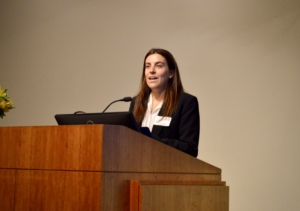
Professor Luft opens the first Compassionate Conversation of the 2026-2027 academic year. Photo by Hannah Park.
Luft began with a statement about the BKI’s guiding ethos and the need that the Compassionate Conversations series fills at UCLA and beyond.
“Kindness is not only a personal virtue, but something we can study rigorously and practice deliberately,” Luft said. “Our Compassionate Conversations series began in 2024 with a simple idea: to bring people together around the hardest subjects of our time, and to model what it looks like to engage them with curiosity, empathy, and respect.”
She then turned to the evening’s theme. “Polarization” was Merriam-Webster’s 2024 Word of the Year, which the dictionary describes as “division into two sharply distinct opposites; especially, a state in which the opinions, beliefs, or interests of a group or society no longer range along a continuum but become concentrated at opposing extremes.”
As a sociologist who has published on division and its consequences in Rwanda and Nazi-occupied France, Luft knows that polarization can be deadly, but also that it is not fixed. Perceptions play a critical role in how it unfolds. People often overestimate how divided their communities are. And when they speak or act on that belief by treating others as hostile or politically and socially estranged, they can make it come true—feeding a vicious cycle of polarization and conflict.
As she introduced Soroka and then Van Bavel, Luft posed the night’s guiding question: “Are we really as divided as we seem?”
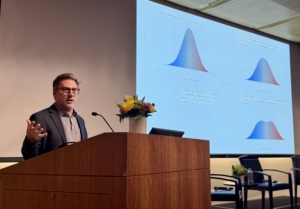
Soroka describes the changing distributions of public, represented, and mediated preferences. Photo by Felicia Graham.
Soroka, award-winning author of several books related to the night’s theme, Andrew Carnegie Fellow, and BKI research grantee investigating potential audiences for kindness, began with an incisive graphical analysis of public preferences. He explained how distributions of opinion become more polarized as they are funneled into represented preferences (in government) and shaped by the media ecosystem (mediated preferences).
The UCLA communication and political science professor emphasized that most individuals’ opinions fall somewhere in the middle, and that being in the middle does not necessarily indicate that one is uninformed. However, people tend to believe that the political landscape is far more polarized. When people elect political leaders, their votes tend to align with parties that thrive on difference, presenting a menu of issues that serve as a useful heuristic (mental shortcut) in voter decision-making. In other words, centralized political institutions tend to present a clearer “us versus them” rhetoric.
Moreover, the media polarizes preferences further. By necessity, journalists condense and select what information to present. Primarily audience-seeking by nature, the media has become even more adaptive to consumer preferences through social media platforms, which Soroka described as a “high-choice environment.”
As media is influenced by negativity biases, in-group biases, and information-processing biases, mediated preferences become even more polarized, which feeds back into greater polarization of underlying public preferences. Thus, perceived differences can drive actual opinions further apart in a self-reinforcing loop.
So, what does this mean for citizens, governments, and the media?
“We can’t throw it all away. We have to recognize, I think, that polarization is one consequence of institutions that we use for a bunch of other things too,” Soroka said. “Looking at all of this together highlights the fact that there actually are multiple points of entry. If what we would like is to change the way the system works … there are multiple things that we can do.”
For example, media ecosystems can be designed to present a distribution of opinions more closely resembling actual public preferences.
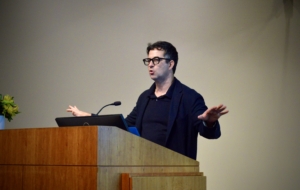
Van Bavel shares social psychology findings about affective polarization. Photo by Hannah Park.
BKI’s second guest speaker, Van Bavel, is the director of NYU’s Center for Conflict and Cooperation. A Clarivate highly cited researcher, the psychology and neuroscience professor studies group identities and cohesion, information processing, and social media engagement and norm creation. His most recent book, The Power of Us (2021), co-authored with Dominic J. Packer, was featured on “The Oprah Podcast” episode, “We’ve Never Been Meaner. Here’s Why.”
Van Bavel tackled polarization using his expertise in social psychology. He specifically homed in on affective polarization, which describes “how we feel about other groups.” Building on Soroka’s description of self-reinforcing loops driving greater polarization, Van Bavel described how they have come to affect American society on a large scale.
“It now seems to have tipped from just basic dislike of other groups to something that feels a lot more extreme, and so we called it ‘political sectarianism,’” Van Bavel said. “It’s a threat to democracy.”
Van Bavel’s research has found that over the last few decades, out-party hate has grown much more than in-party love, which has stayed consistent. This hinders bipartisan cooperation: politicians are wary of being seen working with their counterparts even when they share similar goals. Partisan voters increasingly vote for candidates of their own party, despite personal dislike or awareness of corruption, to prevent the opposing party from gaining power. And research shows that the uptick in polarization has wider ripple effects: Thanksgiving gatherings are shorter, and one’s political affiliation has become a “huge” deciding factor in romantic relationships.
Basic human psychology appears to be wired to pick sides—Van Bavel cited his dissertation research where people identified with and became increasingly biased toward members of their own team, even when teams were assigned completely randomly. However, social media amplifies and proliferates the “us versus them” mindset. Building on Soroka’s analysis of social media, Van Bavel shared his finding that posts attacking political outgroups were the most likely to go viral. He also noted that sectarian language has deepened divisions not only between American political parties but also among academics arguing over research practices. .
“[Academics are] not usually calling people who disagree with you ‘evil’ or ‘sinister’ or ‘immoral,’ but I noticed that that language started to dominate the conversation,” Van Bavel said. “What we found is that when people used moral-emotional language on social media, it was much more likely to spread.”
Posts with words like “hate,” “disgust,” and “contempt” were more likely to get rewarded by likes, shares, and other forms of engagement. This moral-emotional language was strongly linked to polarization and less dialogue across difference, since people who disagreed were less likely to engage with these emotionally loaded posts. All of this contributes, Van Bavel said, to an “age of outrage.”
Van Bavel ended on a more positive note by describing a Stanford study that tested 25 interventions to reduce animosity and polarization—one of them from Van Bavel’s own lab. The three most effective interventions included strategies such as watching a positive contact video (which involved cooperation and equal status roles); revealing media distortions; and highlighting common identity.
Panel Discussion
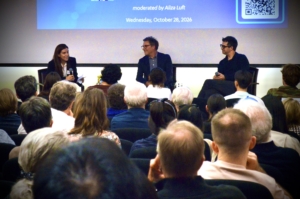
Aliza Luft, Stuart Soroka, and Jay Van Bavel (front, left to right) tackle questions from Luft and the audience. Photo by Hannah Park.
Luft opened the panel by asking Soroka and Van Bavel whether polarization was “necessarily a bad thing,” pointing to political scientist Lilliana Mason’s argument that polarization isn’t the problem but a symptom of deeper fights over power and belonging. Soroka emphasized that while dissensus (differences in opinion) is healthy, polarization is “counterproductive to representative democracy.” Van Bavel also highlighted “mobilization” and “collective action,” as healthier alternatives to affective polarization.
Afterwards, Luft inquired what the average person could do to combat affective polarization. In addition to encouraging people to begin voting at a young age, Van Bavel shared one of his fascinating research findings. When people unfollowed the top 10 most partisan accounts they followed on social media, this led to permanent changes in their “information diet.”
“I like to think of it as: imagine you ate at McDonald’s for lunch every day, and you decided, ‘I’m just going to go a month without it,’” Van Bavel said. “And after that month, you realize, ‘Actually, maybe I feel better’…and so it’s easier to continue on.”
Soroka supported Van Bavel’s recommendation to consume a healthier media diet. He encouraged those with the means to support quality news media financially (such as with paid subscriptions): reliable reporting from trained journalists is worth the investment for individuals and a healthier democracy. Also, he urged listeners to vote in primary elections. Typically, voters with more extreme political views vote to a greater extent in primaries, resulting in candidates with more extreme platforms.
The audience listens intently to the panel discussion. Photo by Hannah Park.
Afterwards, all three panelists empathized with people who fear “saying the wrong thing” (in Luft’s words)—especially college students. They acknowledged the all-too-common pressure to always come with an opinion, and to post and comment about prominent political events on their social media accounts. Soroka, Van Bavel, and Luft emphasized that they strive to make space for their students to admit they don’t hold strong opinions on a topic, or that there are gaps in their knowledge or understanding.
“It’s very easy to forget that, actually, the modal American is in the middle,” Soroka commented. (“Modal” is a statistics term that refers to the most frequent value in a dataset. It is one measure of a statistical “center.”)
The panel closed with a discussion on the harm caused by AI bots, deepfakes, and social media algorithms. Van Bavel pointed out how the sycophantic behavior of chatbots (essentially, flattery) confirms users’ political beliefs and can push them toward extremes. Soroka suggested tuning social media algorithms to surface more balanced content and curb the spread of misinformation. Van Bavel referenced a recent $25 billion fine against Meta, “the largest fine in corporate history,” as one example of an incentive that could spur such design changes.
Finally, Van Bavel reminded listeners that since the most extreme voices tend to post most often, their social media feeds are not a representative sample of opinions. (Furthermore, Van Bavel shared a shocking statistic in his interview with Oprah: “1% of people share 80% of the misinformation online.”)
The night concluded with a reception and book signing, while BKI undergraduate interns collected testimonials and reflections from audience members. Despite the charged atmosphere before the midterm elections, attendees left with a greater sense of understanding of the polarized landscape.
Attendees engage in post-event conversation. Photo by Hannah Park.
Luft in conversation. Photo by Hannah Park.
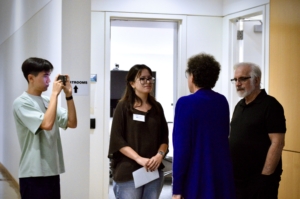
BKI interns Aaden Poyuzina (left) and Maya Church (center) collect audience video testimonials. Photo by Hannah Park.
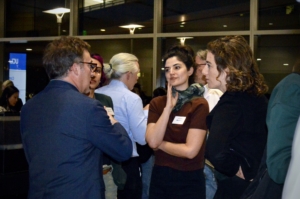
Soroka (left) in conversation with BKI staff. Photo by Hannah Park.
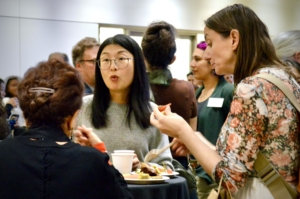
Participants chat during the lively reception. Photo by Hannah Park.
About the Speakers
Stuart Soroka is Professor in the Departments of Communication and Political Science at UCLA. His research examines political communication, political psychology, and the relationship between public policy, public opinion, and mass media, with particular attention to negativity in news coverage and how media shapes democratic life. He is currently an Andrew Carnegie Fellow, leading research on how changes to media technologies can reduce political polarization and serves as Series Editor for the Cambridge Elements series on Politics and Communication.
Jay Van Bavel is Professor of Psychology and Neural Science at New York University and Director of NYU’s Center for Conflict & Cooperation. His research explores how shared identities and beliefs unite people or drive them apart, spanning intergroup conflict, polarization, cooperation, and misinformation. He is co-author of the award-winning book The Power of Us: Harnessing Our Shared Identities to Improve Performance, Increase Cooperation, and Promote Social Harmony (winner of the 2022 APA William James Book Award) and a Clarivate Highly Cited Researcher, ranked in the top 1% of scholars worldwide. Most recently, Professor Van Bavel was interviewed by Oprah about his work on how to restore civility “in a mean world.”
