
Stories of Light: Student-led interfaith dinner gives Bruins a night of storytelling
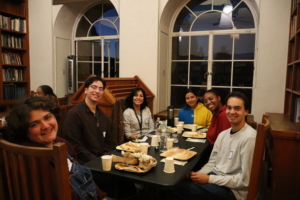
Attendees share their unique spiritual journeys. Photo by Hannah Park.
By Hannah Park, Dialogue Across Difference intern
On April 22, 2026, I hosted Stories of Light: an interfaith dinner dialogue centered around storytelling. Students, staff, faculty, and community religious leaders participated in three rounds of dialogue in the lovely Moore Reading Room and walked away with greater understanding. The event was funded by a grant from the Bruin Bridge Builders Fund.
I felt that an interfaith night of dialogue would be a rare opportunity to learn more about diverse faith practices and combat misconceptions. While some are blessed to know friends from many religious backgrounds, many are hungry to learn but have few people to ask. Moreover, as an English student passionate about creative writing, I fell in love with hearing stories both from religious traditions and personal faith journeys. I envisioned Stories of Light to be a night of listening and sharing—to “lean in softly with a willingness to be changed by what we hear” (Matt Nepo, poet).
The theme of illumination shaped each element of the event, from green candles and glow-in-the-dark animal favors at each place setting to the dialogue prompts participants pulled from mason jars. The three dialogue rounds were titled “Religious Background,” “Religious Practice,” and “Meaning,” and the dark green, medium green, and light green ribbons tied around each prompt jar represented a movement from darkness to light.
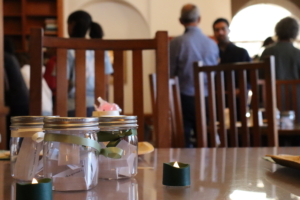
Participants mingle around tables set for dialogue. Photo by Felicia Graham.
After participants settled in, tucking into plant-based food, I gave a few introductory remarks sharing my interfaith journey. Here are a few excerpts from the speech.
“Religious pluralism involves actively bridging across differences with respect and a desire to work for the common good. But it’s difficult, especially in today’s fraught circumstances, to engage with religious “others” … to really see them … to steer clear of generalizations or stereotypes that blind us to our common humanity. This is why interfaith dialogue is essential.”
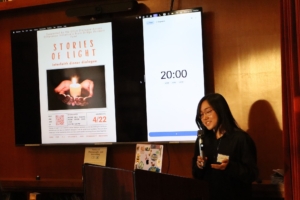
Welcoming the attendees with a short story. Photo by Felicia Graham.
“[In] high school, I did find myself listening to my friend’s Hindu folktales, asking another Buddhist friend what it was like going to temple, and discussing the possibility of the afterlife with my atheist friends. Yet these forays outside of what I saw as my Catholic world often scared me. I wondered whether this curiosity meant I was being disloyal to my spiritual roots.”
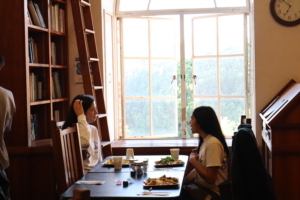
Students share their perspectives. Photo by Felicia Graham.
“Life of Pi illustrates this spiritual dilemma well: the main character, Pi Patel, is an inquisitive teen who tries to practice Hinduism, Islam, and Christianity all at once and is chastised by his pandit, imam, and priest when they discover he’s not only a good Christian—he is a good Muslim and Hindu, too. While the scene is both memorable and funny, it does illustrate the confusion of a young soul who, quote, “just wants to love God,” and is saddened by this apparent mutual exclusivity.”
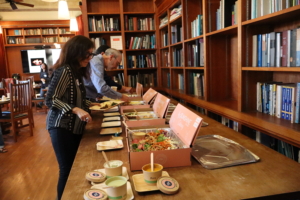
Participants serve themselves dinner. Photo by Felicia Graham.
“[However, at UCLA, I learned that] we can drink in the wisdom of other faith traditions without compromising our own beliefs. Just last month, the Bedari Kindness Institute hosted a multifaith Compassionate Conversation … Valarie Kaur shared a lovely metaphor that I have since taken to heart: religious histories, stories, prayers, and scriptures are like jewels in a treasure chest. While some are jagged and can have the ability to be weaponized, others are lovely diamonds that can help birth the world we want.
And what gems they shared. For example, Imam Turk told us that Islam teaches that we should know our neighbors 40 houses in each direction. That inspired me to learn the names of more people on my dorm floor! And Rabbi Brous shared a prayer that I think of often: “I cried out to you from a narrow place; you responded with expansive possibilities.” Indeed, the fact that we are all here tonight shows that we are willing to expand—to learn—to light new candles of understanding. Light is additive; not competitive.”
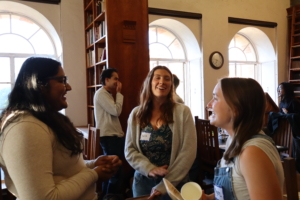
Students laugh and connect. Photo by Felicia Graham.
I closed by acknowledging the diversity of lived experiences, welcoming those of faith and atheist and agnostic participants. I encouraged attendees to listen with an attitude of non-striving, involving active listening without an agenda. Respect does not require agreement, and that rather than feeling pressured to be a “spokesperson” for our spiritual identity, we should share our individual experiences.
Participants then moved into three rounds of dialogue, lasting 20 minutes each. They shared about the first time they realized people held different beliefs, stories about their most profound religious experiences, and times when they felt deeply connected to, or deeply disconnected from being religious.
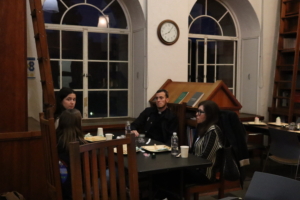
One group listens intently to a story. Photo by Hannah Park.
Small-group discussions allowed many conversational “environments” to exist in the same room. While some tables were more religiously homogeneous, others were more diverse. Some primarily shared personal stories with the rest listening actively, while other groups were quite inquisitive and explored others’ experiences with open-ended questions.
After the event, several participants exchanged contact information to stay connected. Others asked for access to the dialogue prompts so they could use them in their own interfaith conversations. Regardless of specific ideological differences, many walked away with a shared sense of hope, greater belonging, and empathy.
Attendees shared they felt a greater sense of connection. Photo by Hannah Park.
One participant said about the experience, “The jars of questions worked well. I’m now better prepared to understand others by asking about their religious beliefs and customs and how they feel about them.”
Ultimately, Stories of Light strove to support three outcomes: appreciating the beauty of diverse faith practices, revealing common values, and combatting misconceptions. Even with a single night of dialogue, stories linger on in hearts and minds. Dialogue Across Difference student interns are planning future interfaith meetings to keep the candle lit. Sign up for the Bedari Kindness Institute newsletter here to stay updated about upcoming events.
