
Compassionate Conversation: Vice Provost Ralina Joseph launches Racial Exhaustion with a multi-speaker panel and book signing
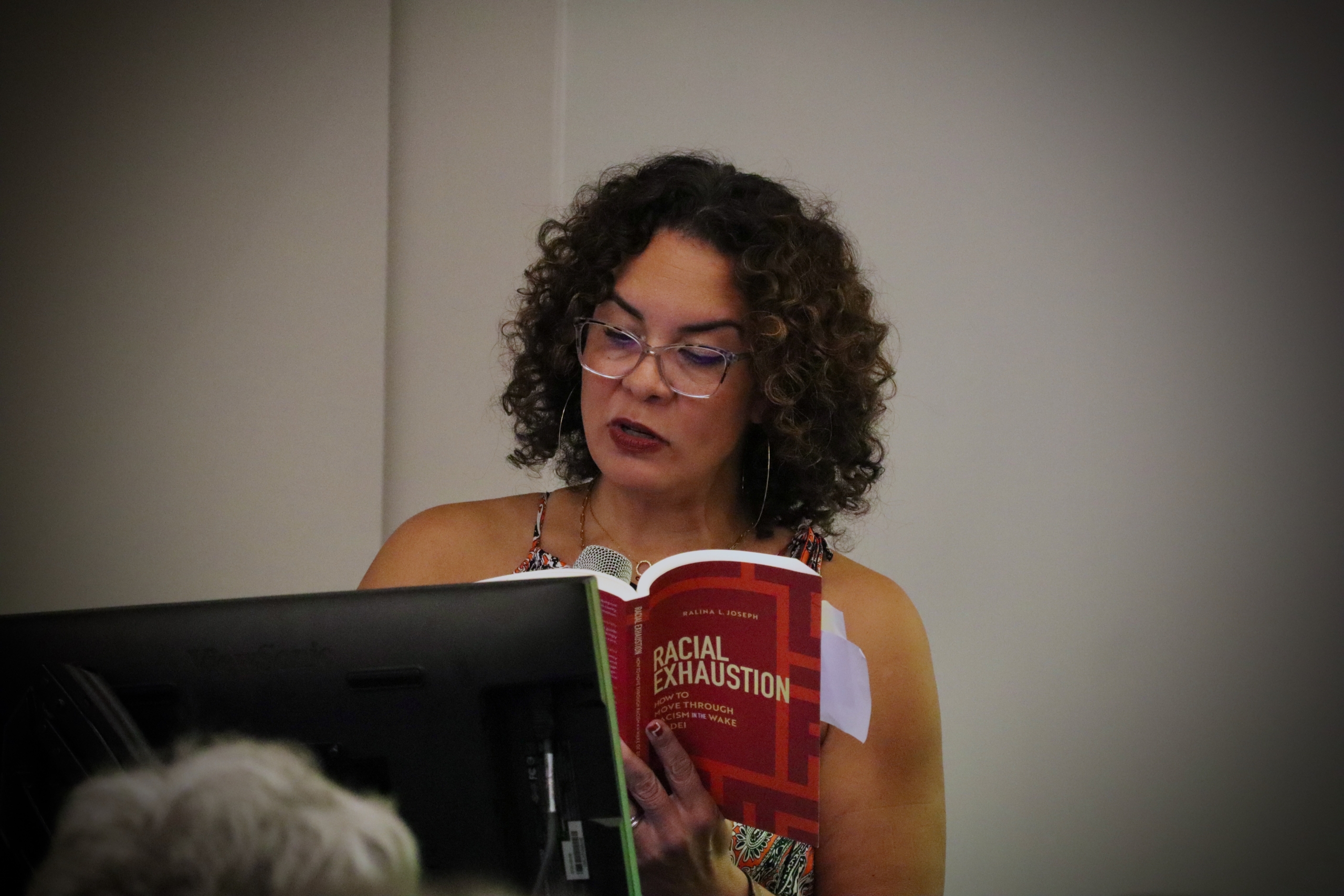
Dr. Ralina L. Joseph reads an excerpt from her latest book, Racial Exhaustion: How to Move through Racism in the Wake of DEI. Photo by Hannah Park.
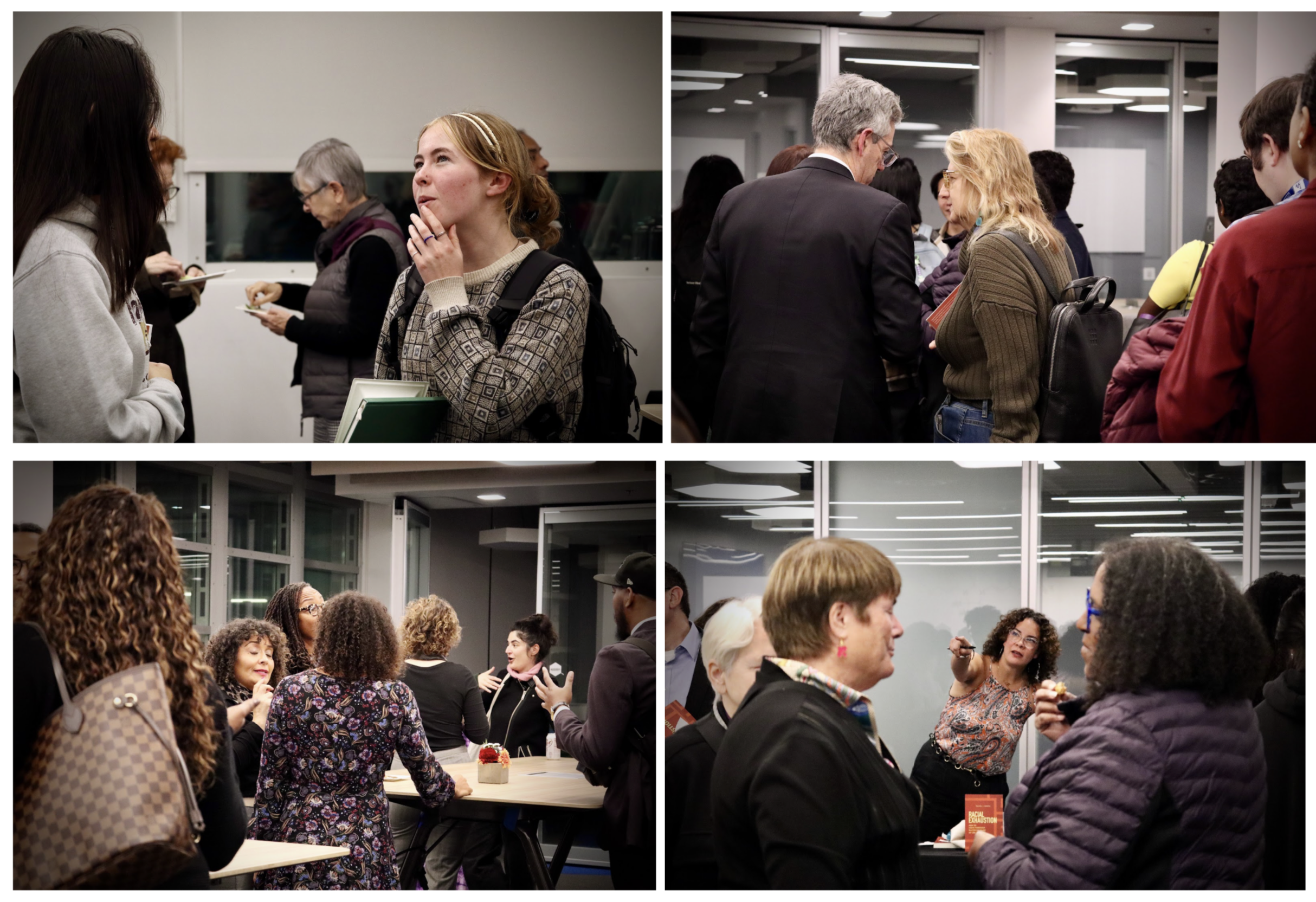
On Tuesday, Dec. 2, the UCLA Bedari Kindness Institute (BKI) hosted the book launch of Racial Exhaustion: How to Move through Racism in the Wake of DEI, by Ralina L. Joseph, the Vice Provost of Inclusive Excellence and Professor of African American Studies at UCLA. Following a reading of her book, Joseph engaged in a dialogue with panelists Prof. Robin D.G. Kelley, Prof. Salma Mousa, Dr. D’artagnan Scorza, with Prof. David Myers as moderator. The event was followed by a book signing and informal dialogue space.
As he welcomed Joseph to the stage, Myers celebrated Racial Exhaustion in glowing terms.
“It is, at once, an illuminating work of analysis, a fascinating self ethnography … of the great project that Ralina started at the University of Washington in Seattle—called ‘Interrupting Privilege’—a revealing memoir, a searing social critique, a bracing challenge to the status quo, and a most useful manual … on how to escape our condition of racial exhaustion,” BKI director and history professor Myers said.
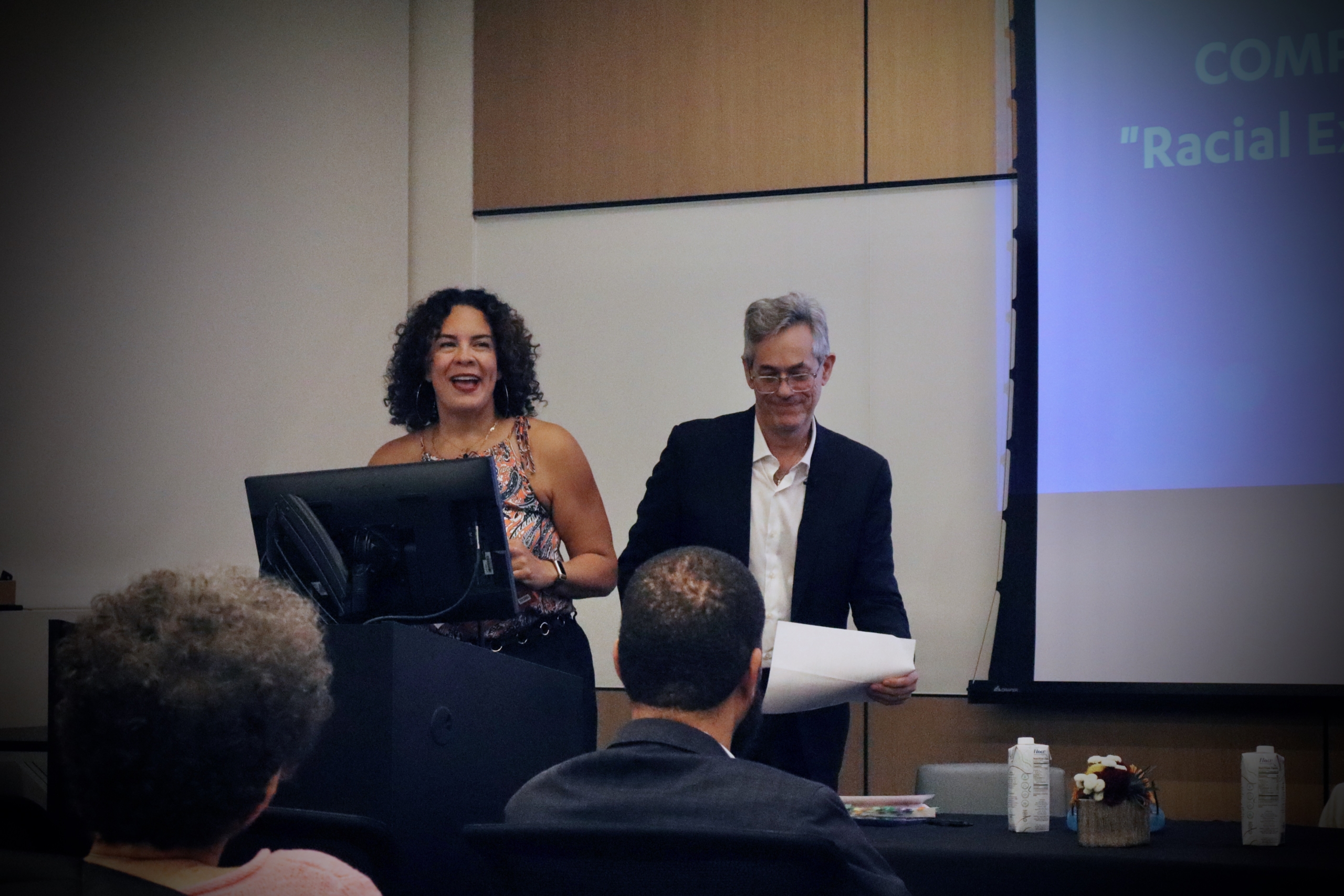
Myers gives Joseph a warm welcome. Photo by Hannah Park.
Joseph then took to the stage to address the audience of fellow professors, students, alumni, and Los Angeles community members. She called her work “theoretical as well as very personal.” She then described the racial dialoguing program that she led in the fall of 2016 that eventually inspired Racial Exhaustion.
“(We brought) people together to have conversations, real conversations, around race,” Joseph said. “This grew to hundreds of people over the Seattle area and beyond, and included kids as young as seven and some elders in their late 70s.”
As an example, Joseph played a clip titled “Let’s Talk About the Angry Black Woman,” which featured a conversation between two female students who shared their first time experiencing discrimination. Joseph went on to read several excerpts from her book, featuring a listening party’s reaction to the very same clip, an explanation of the “angry black woman” stereotype, and the battles against racial exhaustion.
Joseph also related a series of exchanges she had with a white, female participant in her 60s, who first sent Joseph a “very angry” email. After inviting her out to coffee, Joseph read the email back to Barbara, who then admitted she didn’t “really know what [she] was talking about.”
“I think she is working through the white racial exhaustion that emerged in her email to me, simply by showing up [to Interrupting Privilege Events]. As for me, while our coffee shop meeting initially stoked my racial exhaustion, seeing that she is still showing up has helped me move through my own,” Joseph read.
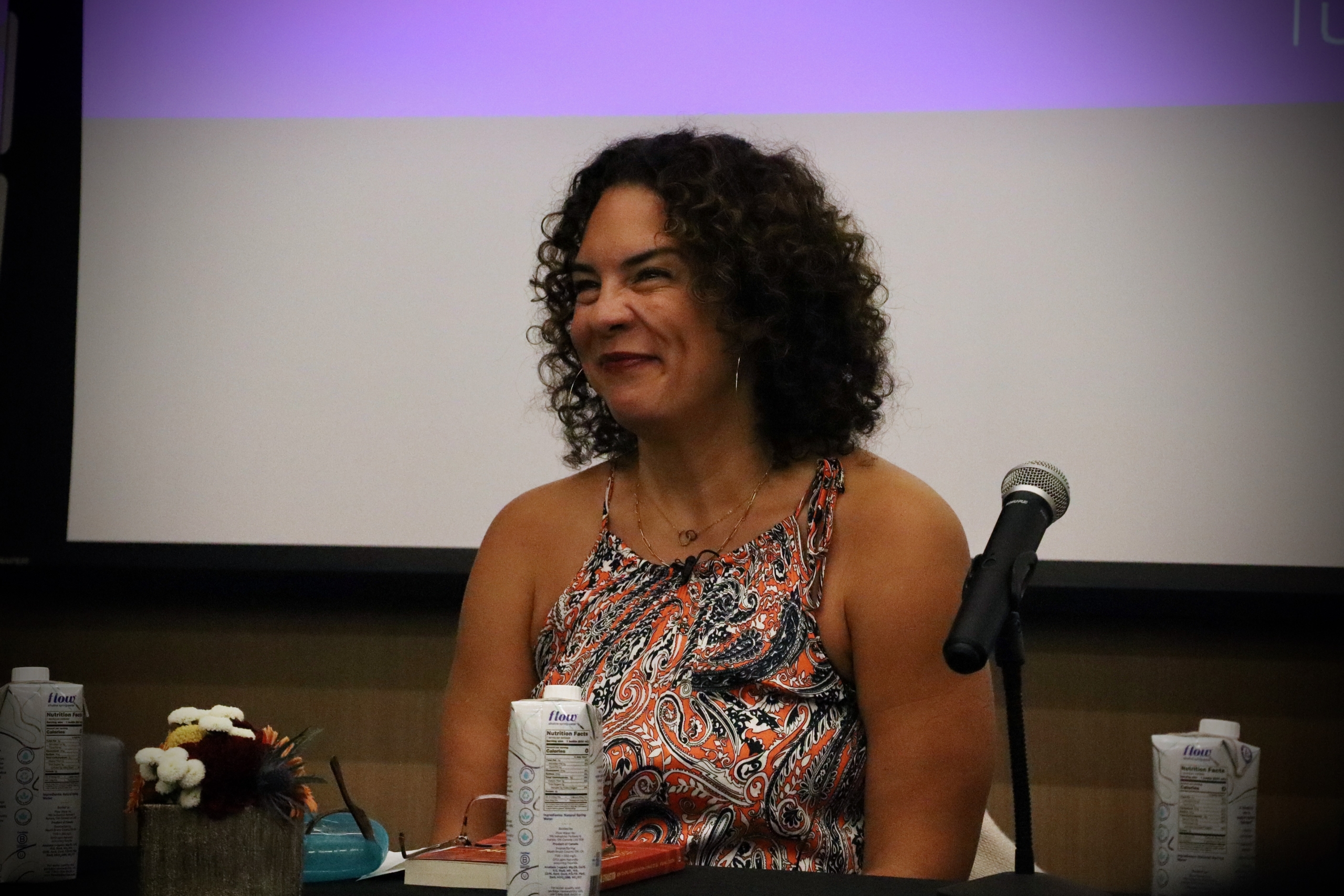
Joseph smiles at the audience. Photo by Hannah Park.
Speaker Panel: Thoughts on Racial Exhaustion
After Joseph’s insightful introduction, Myers invited several panelists to the stage. Mousa, Kelley, Scorza and Myers each shared their reactions to Racial Exhaustion, and how they related Joseph’s methodologies and stories to their own work.
Scorza, the Executive Director of the LA County Anti-Racism, Diversity and Inclusion (ARDI) Initiative, said, “This book was thoughtful, brave and beautifully layered … [Racial Exhaustion] builds upon a long line of critical traditions, but it offers a set of questions about what it means to translate this beautiful pedagogy into institutional and, for me, governmental transformation.”
Scorza asserted that exhaustion, like racism, can be structural—and that how we choose to talk, listen, and interact with others can influence this structure. He also acknowledged the limitations of interpersonal dialogue as a solution to structural exhaustion. As the director of the ARDI, he worked to introduce multiple bills to the state legislature, including one to foster conversations about implicit bias in the workplace.
“I think this is a call to turn this pedagogy into public policy, and I want to thank you for giving us a method … that we can use to carry it forward,” Scorza said.
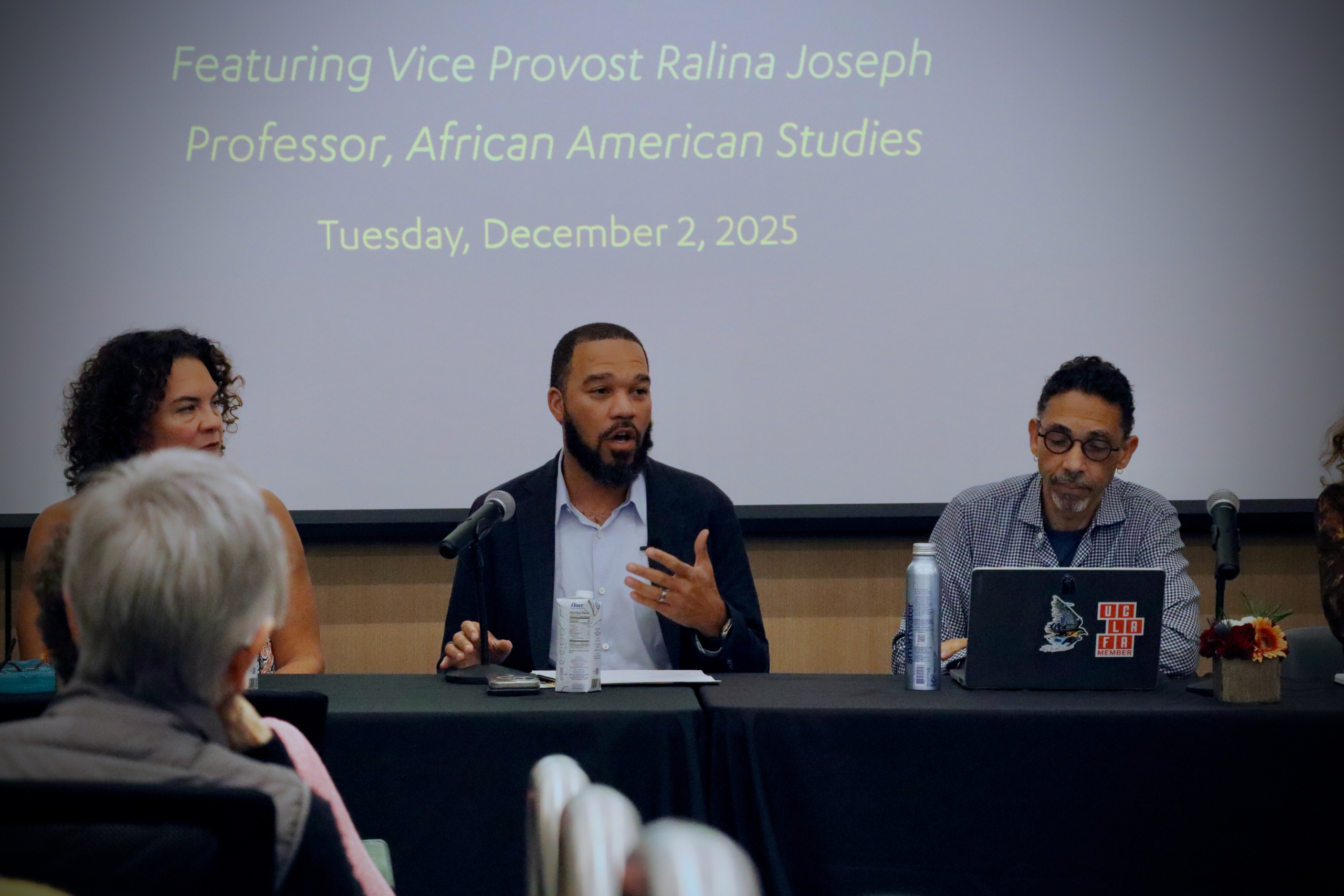
Scorza relates his thoughts on Joseph’s work. Photo by Hannah Park.
Kelley, distinguished professor and UCLA’s Gary B. Nash endowed chair in U.S. History, talked about his own experience with macro- and microaggressions, and how his privilege as a tenured professor and endowed chair allowed him to “call out” others in a way few others could.
He shared experiences of surviving “macroaggressions” like getting beaten by the police and by a white, racist mob in Long Beach. He also shared a story about his first grade teacher making him stand in a trash can and say, “I’m garbage.“
“So I was thinking to myself, with microaggressions, that’s nothing. [But actually], we cannot dismiss these microaggressions because they’re everywhere,” Kelley said.
Moreover, Kelley considered Racial Exhaustion’s impact during the current political climate and its complicated power dynamics, where controversial debates about critical race studies, DEI, and neoliberal “post-raciality” abound.
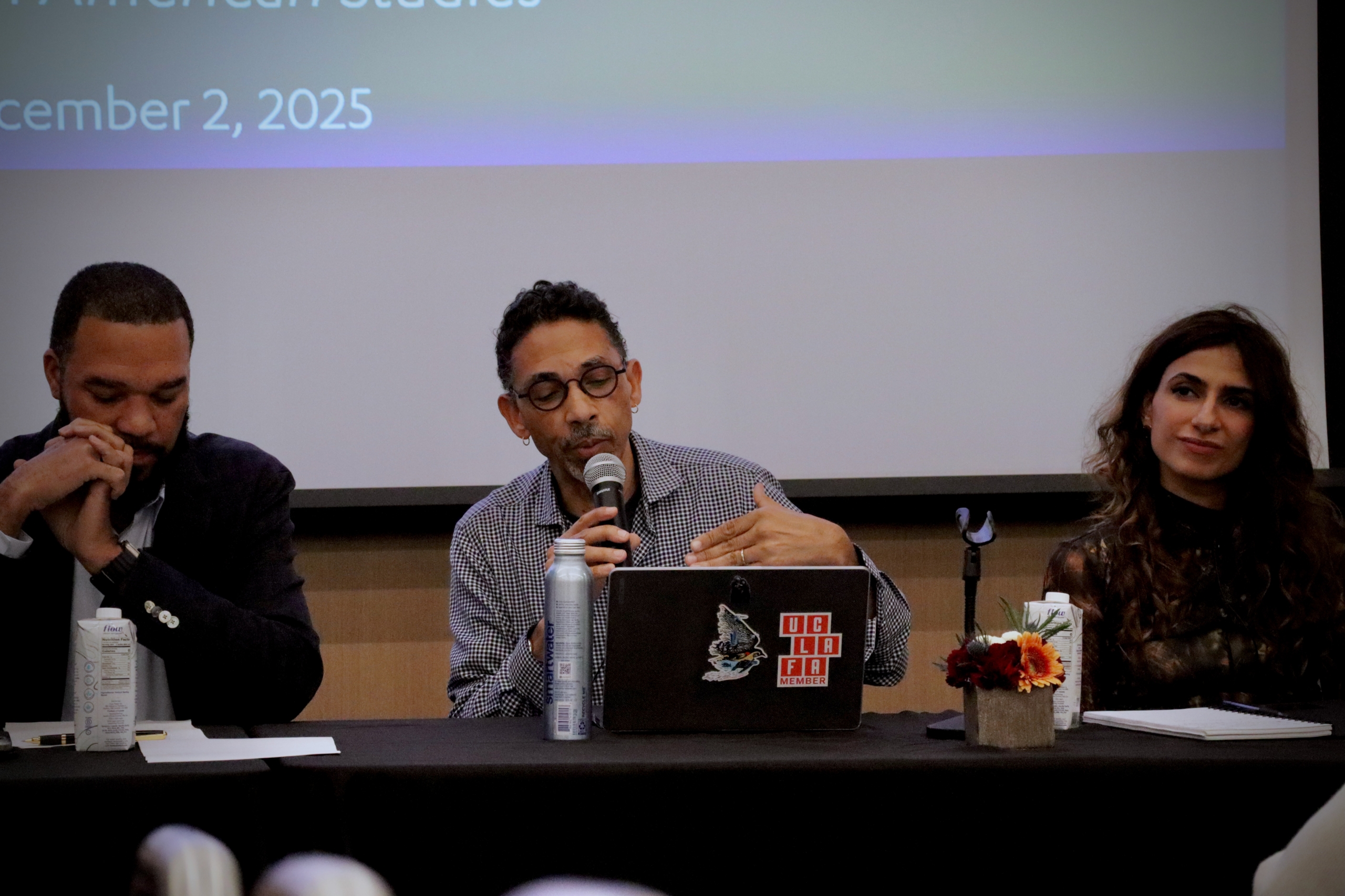
Kelley shares his own experiences and reflections. Photo by Hannah Park.
After Kelley’s remarks, Mousa, assistant professor of political science at UCLA, discussed how Racial Exhaustion answered three critical questions she encountered in her own research concerning prejudice reduction interventions.
Firstly, are members of minority groups expected to carry the burden of reducing prejudice among the majority group by being on their “best behavior” and humanizing their own minority group? According to Joseph, Mousa says, critical conversations about race are meant to have “therapeutic value” for people of color to express themselves, not just combat prejudice.
Secondly, do DEI workshops, conversations, and readings matter? Mousa affirmed their value through Joseph’s anecdotes about how workshop participants return to their communities and inspire meaningful change, as well as an increased ability to handle intergroup conflict through difficult yet focused dialogue.
Finally, Mousa addressed criticisms that dialogue researchers and program leaders are just “preaching to the choir.”
“Well, I’m so glad … that you read out that story about the woman who sent you the email, because clearly we’re not preaching to the choir, right?” Mousa said. “Clearly, a lot of people, despite the fact that they choose to be in that space, are still incredibly uncomfortable.”
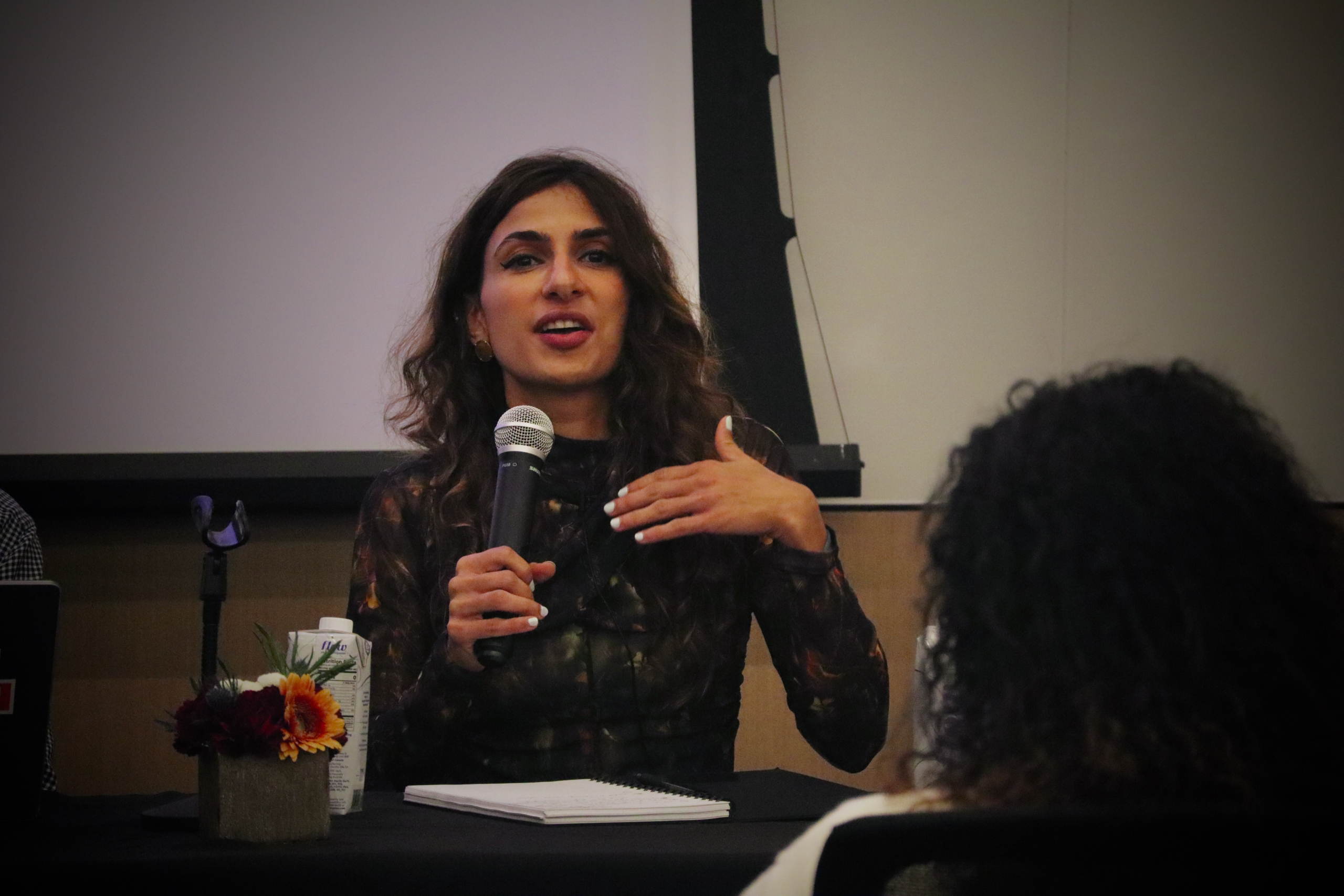
Mousa discusses her research and how Racial Exhaustion tackles some key questions about dialogue. Photo by Hannah Park.
Myers closed out the panel by thanking Joseph for writing a book that forced him to examine his own privilege, yet delighted him by demonstrating some of Joseph’s and Myers’s joint influences like Jewish thinker Martin Buber and Brazilian theorist Paulo Freire. He also reaffirmed the power of dialogue.
“It’s dialogue, not as assent, but as disruption. That’s when it seems dialogue can and must be meaningful…But [there’s] very hard work required to arrive at a position where you are genuinely open to engage another as an equal. It sounds like a banal platitude, but what Ralina does in this book is to make dialogue a very meaningful path to ethical responsibility,” Myers said.
As the speakers transitioned into a Q&A session, Joseph thanked the panelists for their serious and thoughtful engagement with Racial Exhaustion. She expressed sorrow at the intense rollback surrounding diversity and inclusion movements at the current moment. Nevertheless, those who participated in racial dialogues could still find joy, power, and a sense of agency by sharing their stories with others.
In addition to the panelists, one audience member posed two powerful questions: Regina Lee, a fourth-year Public Affairs and Economics student at UCLA.
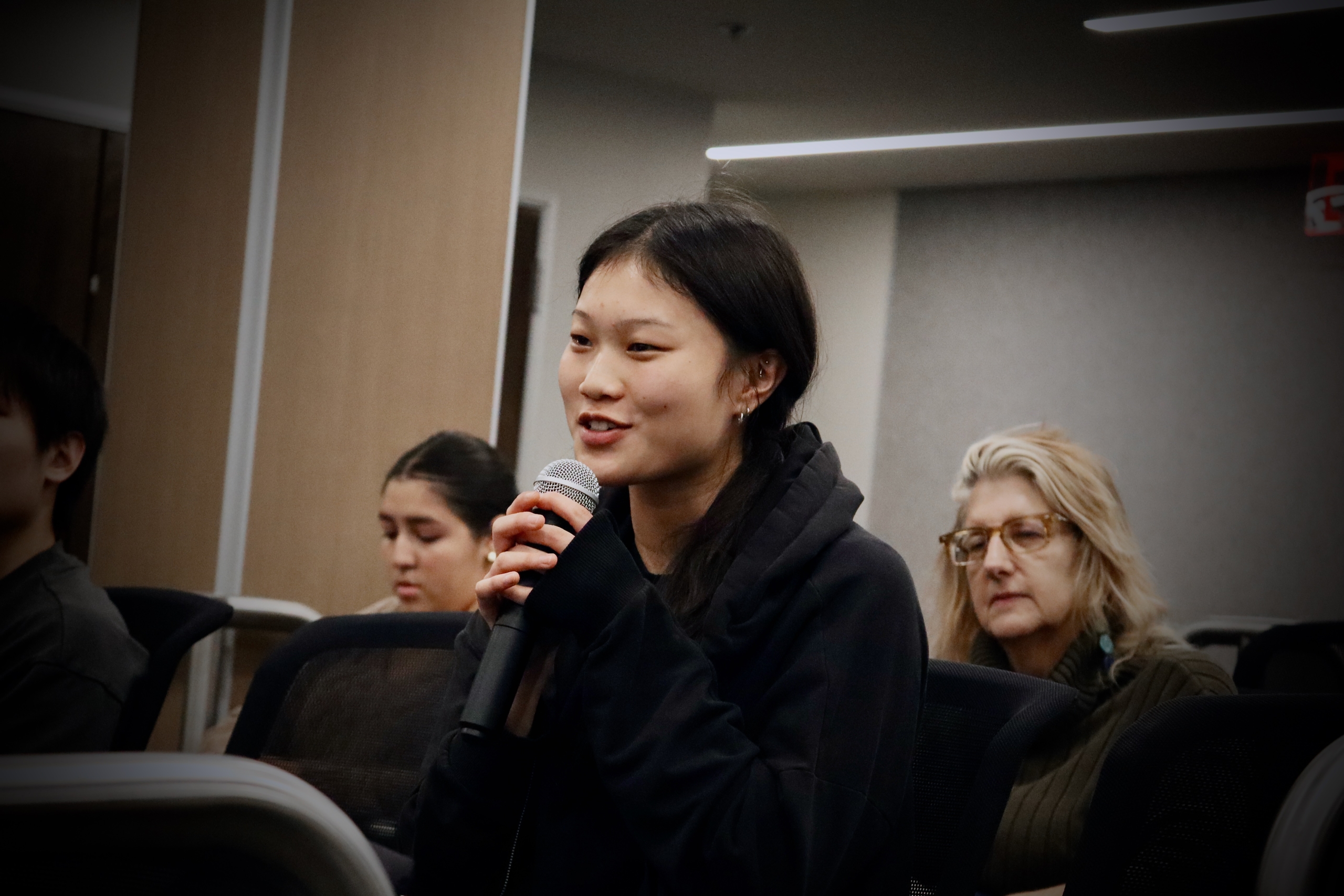
Regina Lee, a fourth-year UCLA student, asks a question. Photo by Hannah Park.
“As someone who grew up in a predominantly white and conservative community, I internalized racial exhaustion … at a young age, and often found it difficult to engage with individuals whose views I perceived as ignorant or even bigoted. And, reflecting on your anecdote about the email you received, Ralina, I’m curious … How do you sustain open dialogue while also protecting your own well-being, especially when such conversations can resurface racial trauma, both personally and intergenerationally?” Lee asked.
Lee also said, “I’m also an intern at ARDI … Through conversations with professionals in the DEI field and looking at the panelists, I’ve observed that much of this work is carried by people of color … But this raises a question I often grapple with: to what extent should the responsibility of advancing DEI fall on those who already bear the weight of racial trauma?”
Prof. Ralina responded by saying:
“You heard me say that it took me a long time, right? … It was really challenging … The training of tons of Interrupting Privilege participants [involved] trying to get folks to realize, and particularly young people … [that] they do not have to put on a superhero cape and dive into the situation … We need for you to also be caring for yourself there … The last thing that we want to do is to exacerbate your racial exhaustion.”
You can purchase a copy of Joseph’s book here (NYU Press link). To stay up-to-date about future Compassionate Conversations, please sign up for the Bedari Kindness Institute’s newsletter here.
About Racial Exhaustion
In Dr. Ralina L. Joseph’s new book, Racial Exhaustion: How to Move Through Racism in the Wake of DEI, Joseph draws on personal narrative, real-world dialogue, and critical race scholarship to explore how radical listening can help us navigate conversations about race. Racial Exhaustion challenges us to recognize and address the fatigue that racial discourse brings while offering strategies to foster more equitable communication and productive change.
About the Speakers
Ralina L. Joseph, PhD is Vice Provost of Inclusive Excellence and Professor of African American Studies at UCLA. Her career spans over two decades of advancing inclusive excellence in higher education. She founded the Center for Communication, Difference, and Equity (CCDE), known for programs like “Interrupting Privilege,” which fosters transformative conversations on race and power. Dr. Joseph is the author of four books, including Racial Exhaustion: How to Move through Racism in the Wake of DEI (NYU Press, 2025). Her research focuses on the intersectional nuances of racialized communication, Black representation, multiracial identity, and women of color feminism. A celebrated mentor and public scholar, Dr. Joseph has received numerous awards and is a frequent speaker nationwide. She is also a mother and community advocate dedicated to using dialogue as a tool for justice.
Salma Mousa, PhD is an Assistant Professor of Political Science at UCLA. She partners with local governments and NGOs in the Middle East (and beyond) to study social cohesion, especially after violent conflict, typically using field experiments. Dr. Mousa’s research has been published in Science and the American Political Science Review, and covered by media outlets like The Economist, the BBC, Der Spiegel, Freakonomics, the Times of London, and PBS NOVA. She received her PhD from Stanford University’s political science department in 2020, and her BSc from Georgetown University in Qatar. Before joining UCLA, Dr. Mousa was an Assistant Professor of Political Science at Yale University.
Robin D. G. Kelley, PhD. is a Distinguished Professor and the Gary B. Nash Endowed Chair in U.S. History at UCLA. A member of the American Academy of Arts and Sciences, he is the recipient of many awards and fellowships, including a Guggenheim Fellowship and the Freedom Scholar Award. His books include the prize-winning Thelonious Monk: The Life and Times of an American Original (Free Press, 2009); Freedom Dreams: The Black Radical Imagination (Beacon Press, 2002, new ed. 2022); and Hammer and Hoe: Alabama Communists During the Great Depression (University of North Carolina Press, 1990, new ed. 2015). His essays have appeared in dozens of publications, including The Nation, New York Times, New Yorker, and The Boston Review, for which he also serves as Contributing Editor. Dr. Kelley also hosted the critically acclaimed podcast, Erroll Garner Uncovered, and has written liner notes for recordings by jazz legends and rising stars.
D’artagnan Scorza, Ph.D., is a distinguished leader, educator, and advocate for justice with a lifelong commitment to transforming communities through education, policy, and civic engagement. He currently serves as the Executive Director of Racial Equity for Los Angeles County, where he leads the Anti-Racism, Diversity, and Inclusion (ARDI) Initiative, which aims to improve life outcomes for all Los Angeles County residents. Dr. Scorza leads policy initiatives using data-driven strategies and equity-centered programming. He is also a lecturer with UCLA Fielding School of Public Health. Prior to joining Los Angeles County, Dr. Scorza was the Executive Director of the Social Justice Learning Institute, a Board Member for the Inglewood Unified School District, and a U.S. Navy Iraq War veteran. Dr. Scorza earned his Ph.D. from UCLA, was an Education Pioneers Fellow and a Business Alliance for Local Living Economies (BALLE) Fellow. He is the author of Healthy Habits for Healthy People, which empowers individuals to cultivate improved health and well-being.
