
Compassionate Conversation: Clean Shelter founders visit UCLA to share humanitarian solutions in Gaza
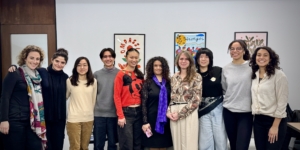
Seba Abudaqa (sixth from left) and Tom Kellner (fourth from right) with DaD staff and students.
By Hannah Park
On Monday, Nov. 17, the UCLA Bedari Kindness Institute (BKI) and Dialogue Across Difference (DaD) Initiative welcomed Clean Shelter co-founders Tom Kellner and Seba Abudaqa to UCLA in the latest installment of the ongoing “Compassionate Conversations” series. Faculty, students, staff, and community members attended the main event, held in Royce Hall, which was followed by small-group dialogue.
According to its founders, “Clean Shelter is a grassroots organization registered in Germany that delivers immediate relief to displaced communities in Gaza…Founded by Seba Abudaqa, a Palestinian from Gaza living between Munich and Cairo, and Tom Kellner, an Israeli [Jewish woman] based in Berlin, the organization focuses on concrete action on the ground, providing shelter, sanitation, and water” (Kellner and Abudaqa).
“Tonight’s event is countergravitational,” Professor David Myers, BKI director, said. “[Abudaqa and Kellner] have maximized their capabilities to help [the] displaced in Gaza…with efficiency and care.”
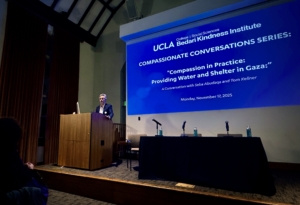 BKI director Prof. David Myers welcomes the audience at the “Compassionate Conversation” Event. Photo by Hannah Park.
The first thing that donors often notice about Clean Shelter is the fact that the NGO is run jointly by a Muslim Palestinian and a Jewish Israeli.
“Because Tom and I work together…people are fascinated by the idea,” Abudaqa said.
But while their identities help draw publicity and donations, they emphasize that they do not see themselves as “representatives” of their respective identities; while it helps create a compelling narrative, they encourage others not to reduce them to their group memberships.
Abudaqa and Kellner met on Oct. 8, 2023, just a day after Hamas attacked Israel (Oct. 7). They were both members of a group dedicated to dialogue across difference between Israelis and Palestinians. However, following the events of Oct. 7, Abudaqa—who had friends and family in Gaza—decided to leave the group.
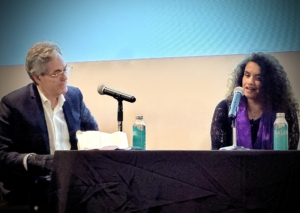 Abudaqa shares her experience with Prof. Myers. Photo by Hannah Park.
“I was overwhelmed by the genocide and destruction in Gaza…I wasn’t able to be there [on the ground]…I felt like dialogue was a luxury,” Abudaqa said.
However, after Kellner reached out to Abudaqa to voice her solidarity, the two felt a bond and began to talk about how to help provide aid to Gaza. They crafted a Facebook post asking friends and family for donations. After they raised fifteen thousand dollars in two months—the legal limit in Germany for independent beneficiaries—they were required to create an NGO. From this humble beginning, Clean Shelter grew to an organization that assists hundreds of thousands of Gazan IDPs (internally displaced persons) today.
Clean Shelter’s transparency and nonpolitical stance appealed to many donors in the aftermath of Oct. 7. To alleviate the pervasive fear that “every cent you give goes to Hamas” (Kellner), Clean Shelter espouses concrete objectives like building toilets, repairing desalination units, and running two IDP camps (named Zomi and Mariam) with a special focus on women, the elderly, and the disabled. Moreover, every person who donates gets access to an anonymous log that records how donations are used.
Clean Shelter’s mission is to fill the gaps left by larger NGOs: toilets, for example, increase privacy for women in crowded camps. Due to its small size and specific focus, Clean Shelter can respond to crises within hours; it is flexible, dynamic, and fast. For needs that fall outside water and sanitation, it collaborates with other organizations such as World Central Kitchen and UNICEF.
During the pre-event conversation with BKI staff and student interns, Kellner handed out postcards that featured photos of IDP camps as part of their advocacy work to “re-humanize Gaza.” Many people across the globe know very little about what an actual camp looks like, they said.
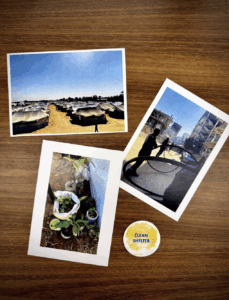 Clean Shelter’s postcards feature an IDP camp, water networks, and innovative gardening solutions. Photo by Hannah Park.
Kellner and Abudaqa call Gaza a unique disaster zone: all supplies have to be sourced within Gaza itself, since very little can get in from the outside. They need to locate local materials to build items such as toilet seats, and they take a bottom-up approach by selecting committees to handle the day-to-day logistics of running IDP camps.
Abudaqa is especially proud of the women, including mothers and high school and university students who had never worked before, who run these committees and organize educational and recreational activities on the ground. They even created a study room with stable internet that allowed high school students in Gaza to take important exams.
“Now they are celebrating the graduation of many high schoolers who took their exams in that room,” Abudaqa said.
The latter half of the conversation was dedicated to Clean Shelter’s work in creating “water stability”: increasing accessibility to clean drinking water and ensuring that refugees would not have to queue long hours to obtain this essential resource. Since relying on outside sources of water is often unreliable and expensive, Abudaqa and Kellner prioritize obtaining and repairing desalination units.
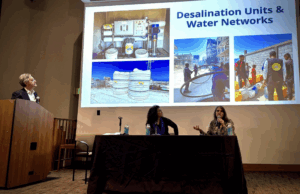 Kellner speaks about Clean Shelter’s mission to improve access to clean water in Gaza. Photo by Hannah Park.
Before the conflict, desalination units were widespread in Gaza. Even small houses contained units, which were a key source of clean drinking water. However, finding working units within Gaza now is one of Clean Shelter’s main challenges. Sometimes important machinery is destroyed or bombed in transit, which makes sourcing these technologies even more difficult.
Finally, Kellner and Abudaqa addressed what was, to some, the elephant in the room—their “nonpolitical” stance.
“We are not a political organization,” Abudaqa said in the intimate pre-event dialogue. “People are nagging us to talk about politics.”
“We do get criticized for that, and rightly so. Everything is political…[and it] can seem naïve and evasive to say, ‘We don’t do politics,’” Kellner said. “[But I’m surprised by] mind-boggling questions like, ‘Does everyone deserve medical aid?’ People deserve water.”
Kellner added during the following Q&A session, “Humanitarian aid is not a question of politics. It is a basic, basic thing that has to do with ethics, morality, and human rights.”
Q&A
After the main conversation among Myers, Abudaqa, and Kellner, questions were posed by the audience. Here are a few highlights from that conversation.
Q: “If one saves one life, it is as if they save the entire world.” This is a statement common to both Judaism and Islam. But the scale of destruction is so great. How do you keep from lapsing in despair?
Abudaqa: “It’s a drop in the ocean. We feel helpless all the time…We feel like we have to do more. People shouldn’t be living in tents for two years.”
Kellner: “For me, it’s an endless movement between, ‘Okay, we’re doing the best we can, we’ve helped 150,000 people. Okay, that’s substantial.’ And some mornings, I wake up and say, ‘That’s nothing. We have to do so much more. [It’s a] glass half empty, half full [mentality].’”
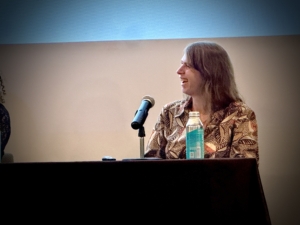 Kellner smiles while answering a question. Photo by Hannah Park.
Q: What is the story behind the names of your two refugee camps?
Paraphrased: Zomi was a friend of Abudaqa’s who was killed in the conflict, and Mariam, Abudaqa’s cousin, was a journalist who was killed with four other colleagues in a hospital. They continue to name facilities and infrastructure after women who have died in the war, including Vivian Silver, a Jewish Israeli peace activist who was killed on October 7 in southern Israel.
Conclusion
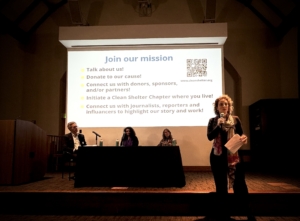 Deputy Director Maia Ferdman addresses the audience at the conversation’s close. Photo by Hannah Park.
After the Compassionate Conversation came to an end, the audience was invited to stay and process what it heard. The room was divided into groups of three to five members. The groups shared without interruption for about 20 minutes, getting to know strangers from different areas of campus and the greater Los Angeles Community.
“Only speak for yourself, on behalf of yourself,” Maia Ferdman, deputy director of the BKI, said. “Listen with fullness to the person in front of you.”
Clean Shelter’s next steps prioritize obtaining more tents and desalination units, then moving to secure more permanent housing solutions. The organization encourages spreading the word about its cause and even initiating local Clean Shelter chapters for motivated individuals. For more information about their organization, please visit www.cleanshelter.org. And to stay up-to-date about future Compassionate Conversations, sign up for the Bedari Kindness Institute’s newsletter here.
About the Speakers
Tom Kellner is the co-founder and Executive Director of Clean Shelter. She is an Israeli-born literary scholar and cellist, a hard-headed feminist and a pragmatic idealist.
Seba Abudaqa is the co-founder and Director of Operations of Clean Shelter. Born and raised in Gaza, Abudaqa obtained her degree in the West Bank, and works in community empowerment and sustainable development.
(Source: cleanshelter.org)
