
BKI hosts joint seminar with ISH/BKI researchers on hate and kindness
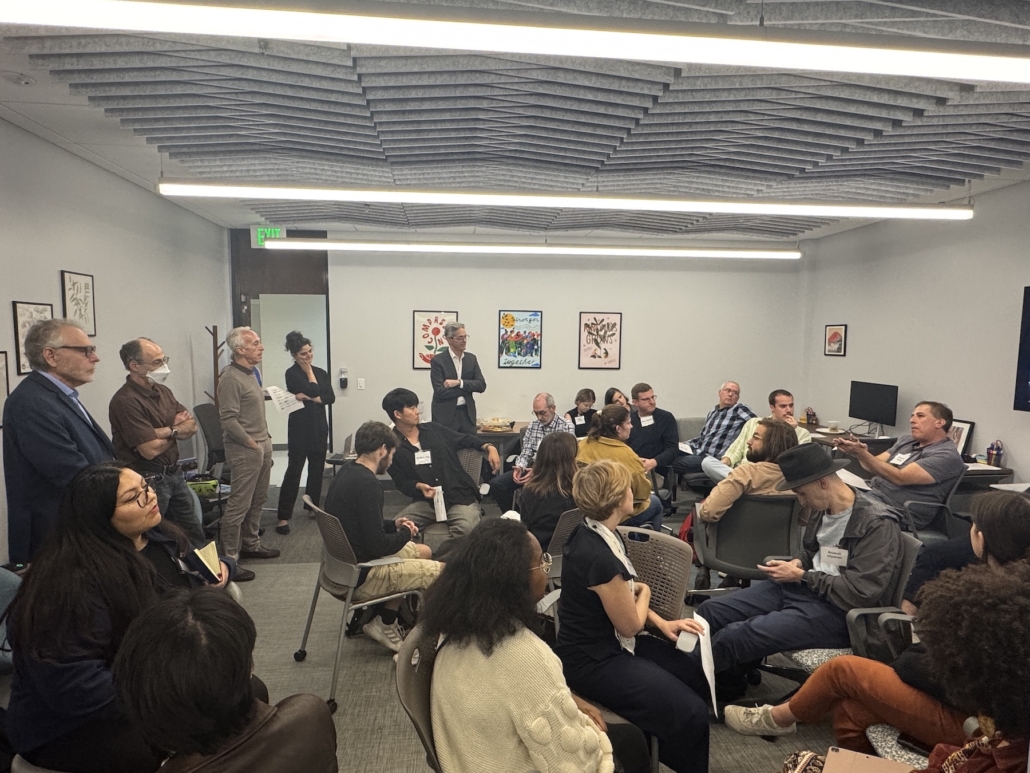
The final meeting of the fall quarter marked a joint conversation between the Initiative to Study Hate and the Bedari Kindness Institute (BKI), featuring Dr. Daniel Fessler, professor of anthropology at UCLA and founding director of BKI and Dr. Mario Mendez, a behavioral neurologist and emeritus professor at UCLA. The discussion centered around a deceptively simple question—one the Initiative has come back to again and again, and one that different disciplines continue to define in conflicting ways: what is hate and how does it actually operate in human cognition and social life. This question shaped a second, more urgent one: if hate is durable and structurally embedded, how might re-humanization actually occur?
Fessler pushed against the instinct to understand hate as an emotion. He described it instead as an enduring orientation toward others—an attitude in which a person or group is understood as an exclusive source of cost. Hate, in this sense, is not hot or reactive; it is structurally quiet. Once someone is encoded as a threat, their actions are easily read as violations and rarely as cooperative or meaningful. From this perspective, re-humanization cannot be achieved through emotional appeal alone. It requires altering the underlying representation—shifting how others are cognitively understood in relation to one’s own well-being.
Mendez approached the same problem through a different register, describing hate as a moral sentiment—durable, value-laden, and embedded in affective and neurological systems. When he turned to re-humanization, his emphasis became strikingly concrete. Dehumanization, he argued, thrives on homogenization, on the collapse of many people into a single, undifferentiated category. Re-humanization begins by reversing that process. “Humans come in packages of one,” he noted, which means restoring individuality: giving each person a name, exchanging personal information, reactivating theory of mind, and recognizing that moral life is always lived at the level of singular persons rather than abstract groups.
Although Fessler and Mendez used different language—attitude versus sentiment—their accounts converged in regard to how hate operationalizes. Hate depends on abstraction. It relies on shallow representations that flatten difference and make exclusion feel justifiable. Re-humanization, by contrast, is not a sentimental gesture but a structural intervention. It challenges those representations by insisting on specificity: this person, this history, this set of relationships. For Fessler, that specificity disrupts the idea that others are exclusively costly by revealing the possibility of mutual benefit or cooperation. For Mendez, it counteracts the neurological and moral shortcuts that allow people to disengage from others’ inner lives altogether.
Both emphasized that dehumanization alone does not produce violence; it lowers perceived moral value and sets the stage for harm. The decisive work happens in the space between perception and action. That space—where narratives, incentives, and social arrangements operate—is also where re-humanization can take hold. Individualization does not guarantee empathy or agreement, but it complicates expulsion. It makes it harder to sustain the fiction that “they are all the same,” or that exclusion can occur without moral consequence.
The conversation ultimately reframed re-humanization as a process rather than an outcome. It is not a return to some abstract ideal of shared humanity, nor a simple appeal to dignity. It is the deliberate restoration of specificity in a world that constantly pressures us toward generalization. Hate may be a stable way of organizing the social world, but re-humanization, as both speakers made clear, begins wherever abstraction and essentialization break down—one name, one story, one person at a time.
